
Build Muscle Memory.
Write Kanji Without Hesitation.
A mastery-first writing system. No points. No streaks. No ads. One continuous, distraction-free stream that builds zero-hesitation recall — character by character, stroke by stroke.
Start Writing ✍️Beyond Gamification.
Into Mastery.
Most language apps optimize for engagement metrics — points, streaks, and leaderboards that keep you tapping, not learning. KanjiObsession optimizes for one thing only: permanent recall.
| Typical Language Apps | KanjiObsession |
|---|---|
| Points, XP, and leaderboards | Mastery-based progression — you advance when you can write it |
| Streak pressure and daily nags | Learn on your schedule. No guilt mechanics. |
| Banner ads and upsell pop-ups | Zero distractions. Pure writing surface. |
| Multiple choice recognition | Handwrite every character. No guessing. |
| Monthly subscription | Pay once. Own it forever. Works offline (requires internet check once every 3 days on Android). |
| Randomized review order | Topological ordering — building blocks first |
The Component Blueprint Method
Complex Kanji are assembled from simpler ones. KanjiObsession maps the entire writing system into a dependency graph — you always learn the building blocks before the characters that need them.
Dynamic Kana & Syllabary Mastery
Before encountering each Kanji, the app drills the Hiragana you need for its kun-yomi (native Japanese reading) and the Katakana for its on-yomi (Sino-Japanese reading). Master all 98 Hiragana and 128 Katakana characters — including diacritics (dakuten) and contracted sounds (yōon).
Additionally, the top 1,000 Katakana loanwords (外来語) — from modern everyday terms to technical vocabulary — are systematically interleaved across the levels, cementing muscle memory for both modern Japanese and traditional Kanji literature.
Perfect Execution, Not Self-Assessment
Most spaced repetition systems ask you to rate your own recall ("Was that Easy, Good, or Hard?"). That's unreliable. We enforce perfection instead.
Write from Memory
A character appears. You must write it — correct stroke order, correct form, from memory alone.
Hesitation Detection
Pause too long? A hint appears automatically. The system notes you weren't fluent yet.
Repeat Until Flawless
You repeat the character until you can write it without pause, without hints — pure muscle memory.
Why We Don't Use Quality Scores
Traditional SRS systems like SuperMemo-2 rely on the learner self-reporting recall quality on a 0–5 scale. This introduces subjective bias — overconfident learners advance too fast, anxious learners waste time on material they already know.
KanjiObsession eliminates this variable entirely. We don't ask you to rate your recall. We measure it. If you can write the character from memory without hesitation, you know it. If you can't, you repeat it. The algorithm is binary: perfect or not yet.
The result is a session where every character reaches 100% execution quality before you move on. No character slips through with a "3 out of 5" rating. Every stroke is earned.
Explore App Features
Click any screenshot to zoom and preview actual in-app practice modes.
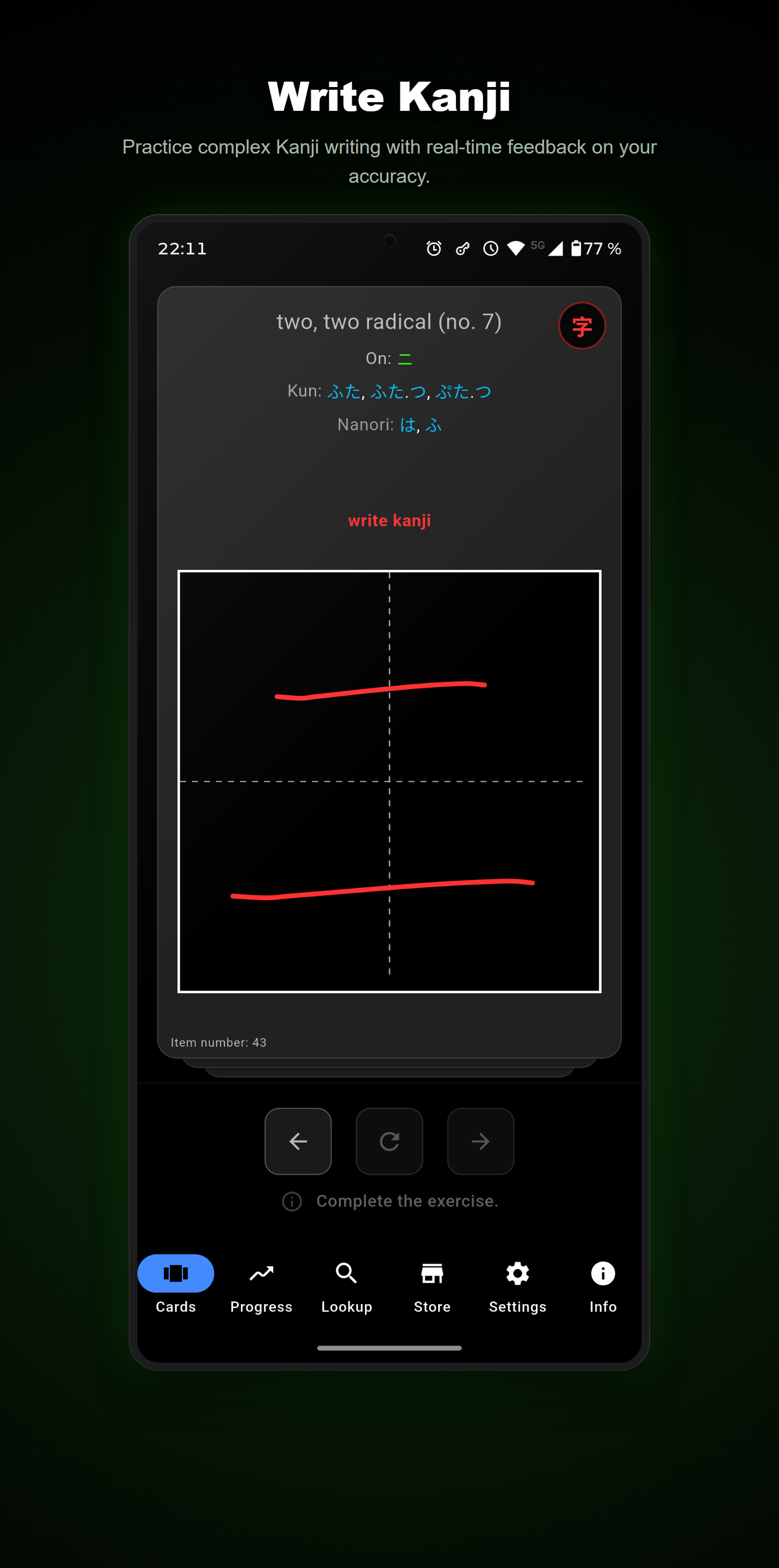
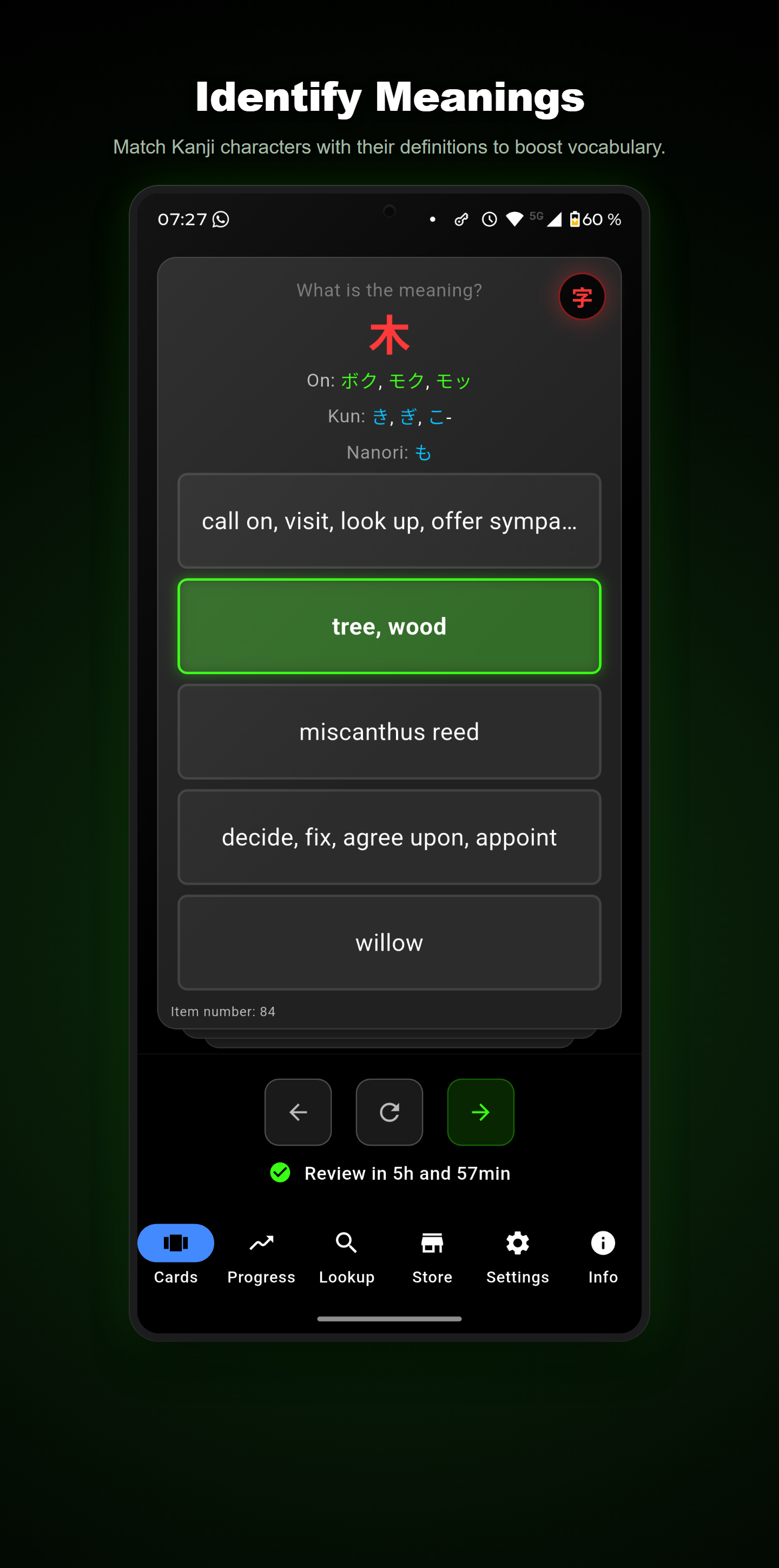
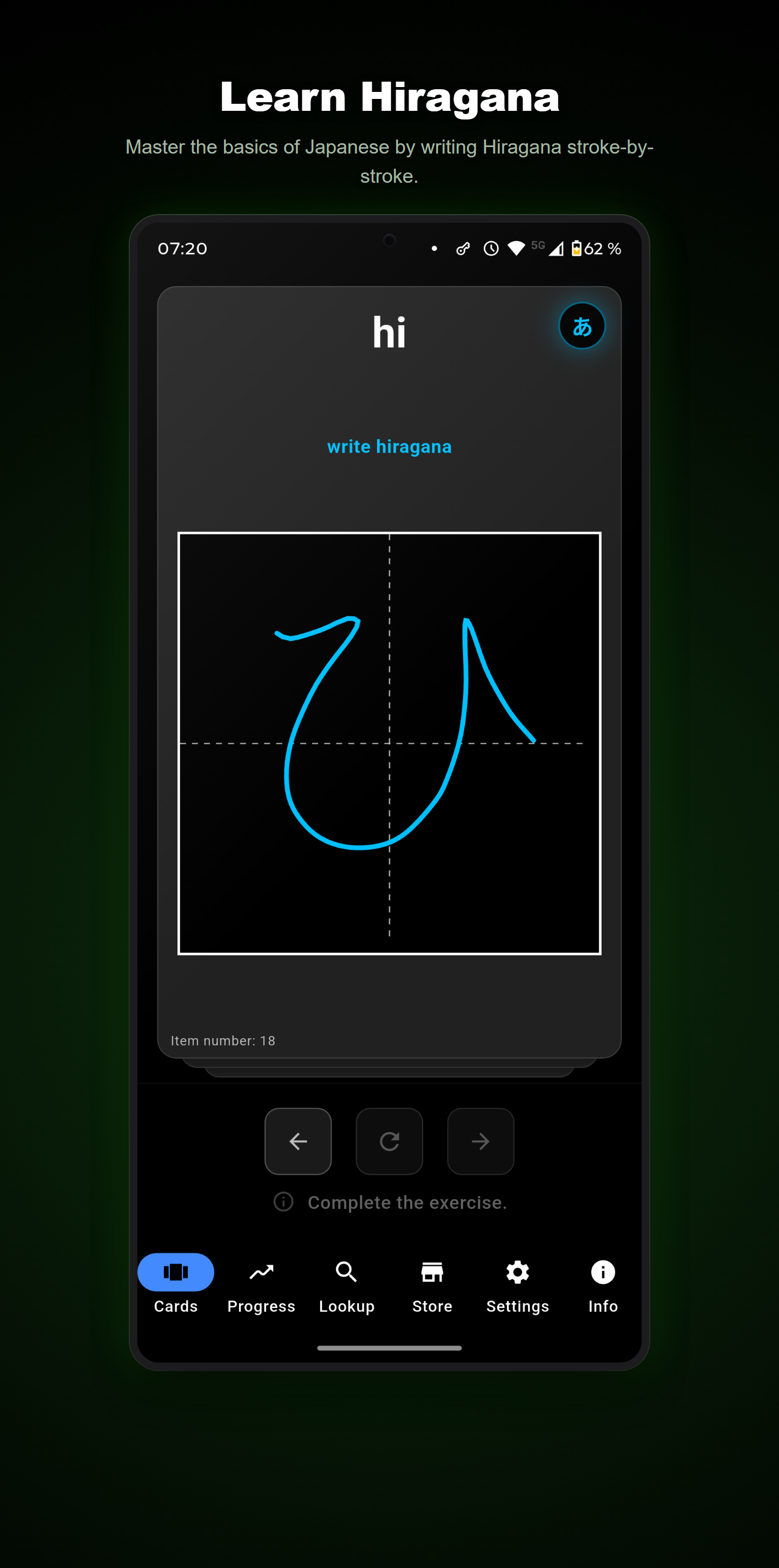
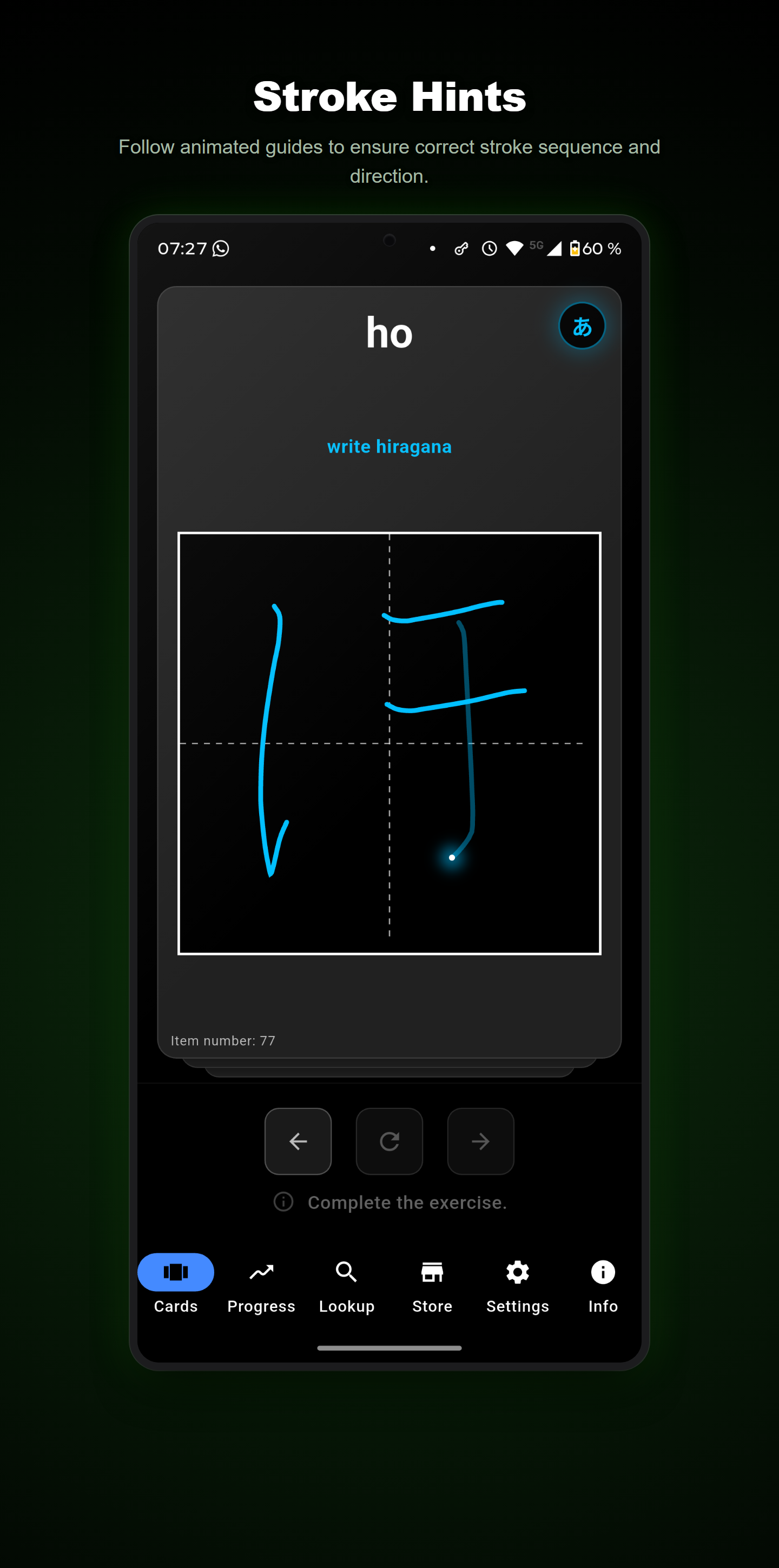
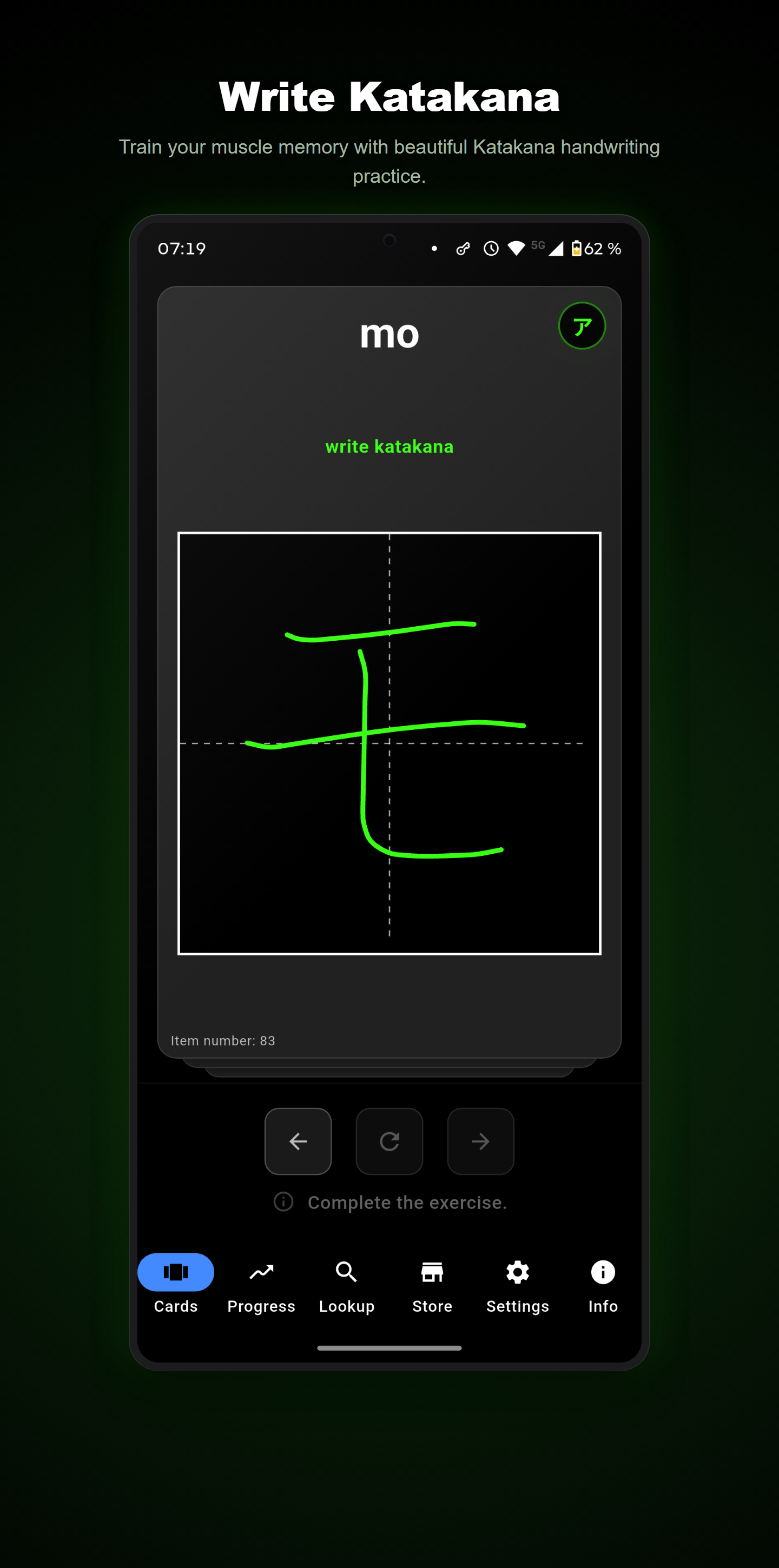
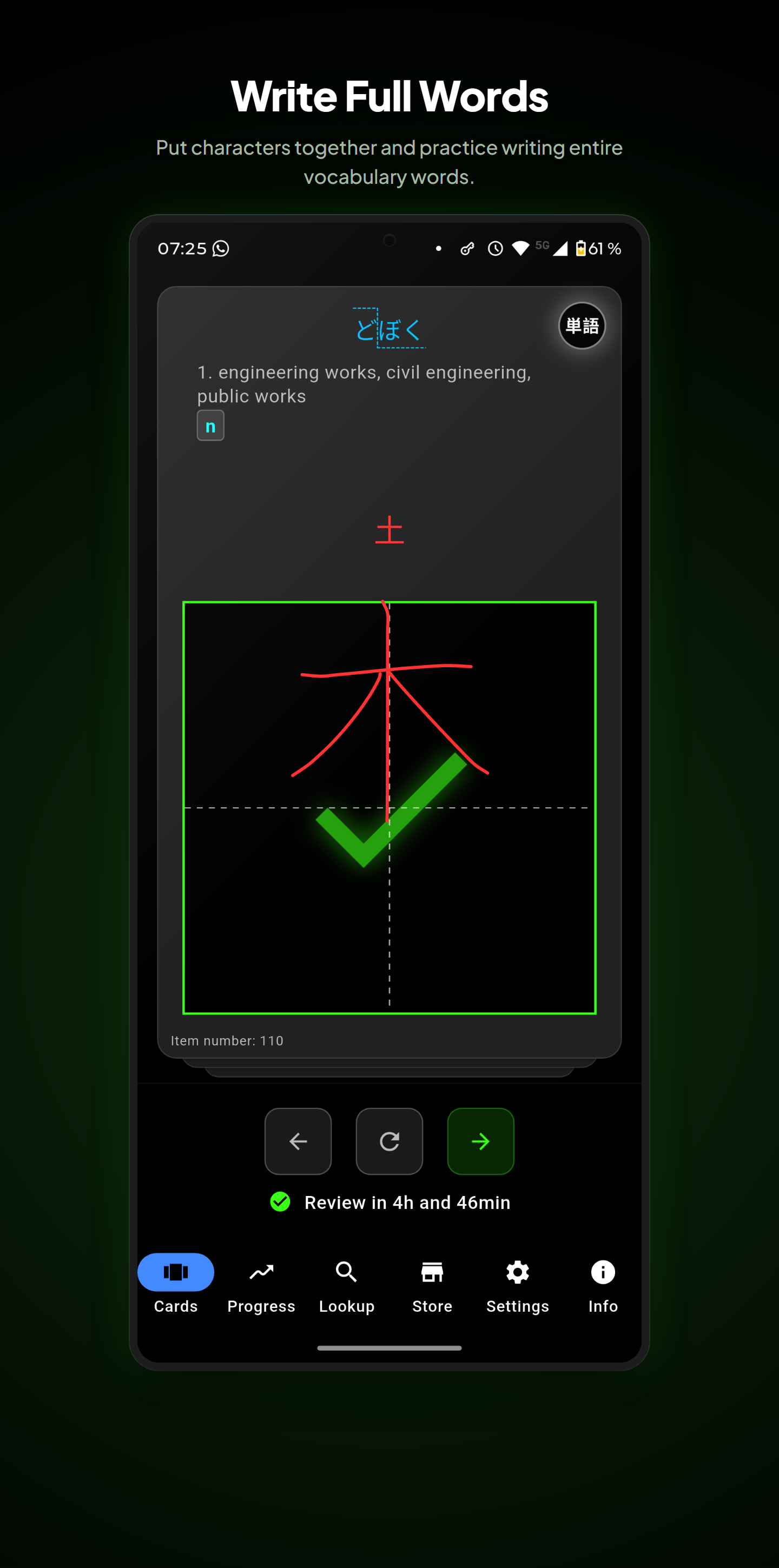
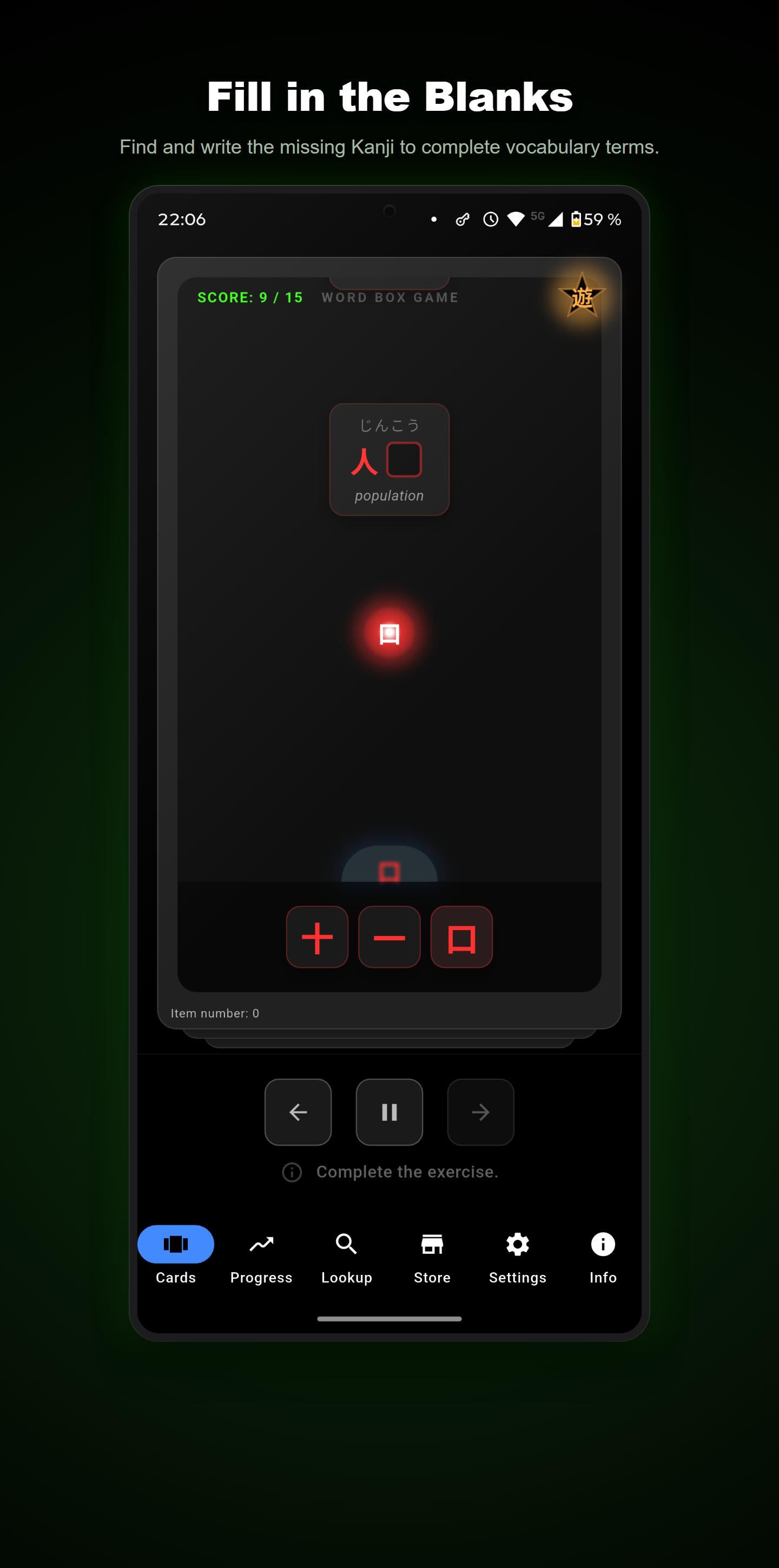
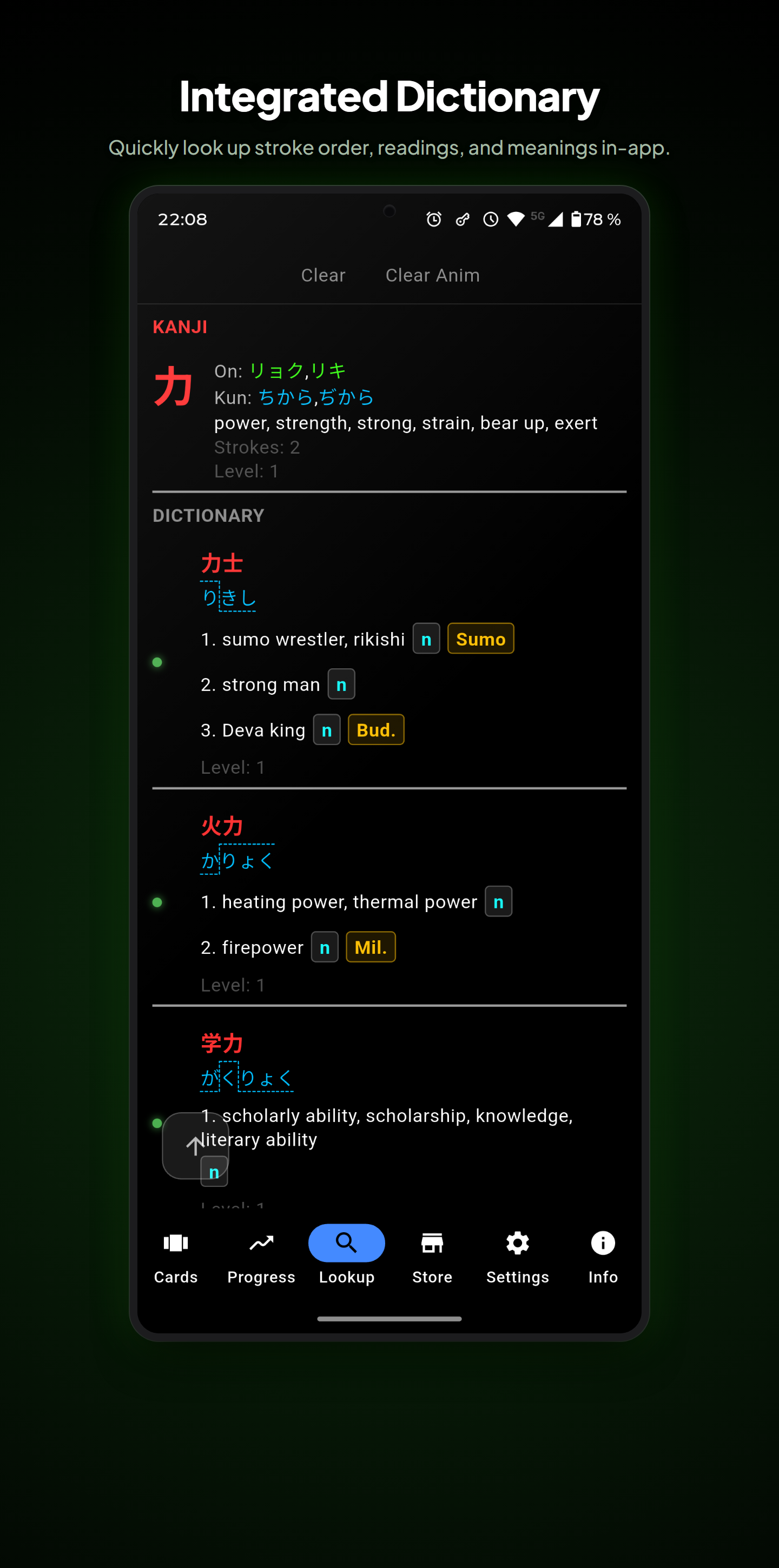
From Characters to Words — Instantly
Isolated character drills aren't enough. The moment you unlock a new Kanji, you immediately write high-frequency words that use it — cementing muscle memory in real-world context.
After mastering 日 and 本 individually, you're immediately asked to write the word 日本 (Japan). The dependency graph ensures you've already practised every component — so the word feels natural, not overwhelming.
Words are sorted into the same dependency tree as individual characters. You never encounter a word before you've mastered every Kanji it contains. This eliminates guessing and builds compound recall from the ground up.
From First Stroke to Native Fluency
A comprehensive, structured roadmap covering 2,978 Kanji, 29,630+ Vocabulary Words, and 204 Kana. Every level builds upon the previous using topological dependency ordering.
Kana & Essential Kanji
Master the complete Hiragana and Katakana syllabaries, over 1,700 fundamental Kanji building blocks, and high-frequency foundational vocabulary.
Core Kanji & N1 Literacy
Unlock 368 core Joyo Kanji and nearly 6,000 compound words to achieve full everyday literacy and JLPT N1-equivalent reading comprehension.
Broad Vocabulary Extension
Harness 299 advanced Kanji and over 6,000 nuanced literary compounds, idiomatic expressions, and cultural vocabulary.
Advanced Native Fluency
Command 271 complex characters and specialized vocabulary spanning business, technical, news, and native conversational Japanese.
Academic & Literary Mastery
Conquer 331 scholarly Kanji and over 6,300 rare literary words, classical readings, and formal academic Japanese.
Notebook Grids & Ministry Standards
True Japanese handwriting mastery requires proper spatial balance. KanjiObsession implements authentic cross-guided notebook grids (マス目) in strict conformance with Japanese Ministry of Education (MEXT / 文部科学省) elementary school curriculum guidelines.
Proper Balance for Contracted Sounds & Digraphs
In Japanese elementary school handwriting instruction (書写指導 / 小学校学習指導要領 国語編), character balance is taught using 4-quadrant cross-guided squares (十字リーダー入りマス目).
While regular Kanji and Kana center across all four quadrants, contracted sounds (拗音: ゃ, ゅ, ょ), double consonants (促音: っ), and small Katakana (ァ, ィ, ゥ, ェ, ォ, ッ, ャ, ュ, ョ, ヮ) must occupy a quarter of the grid box situated in the lower-left quadrant (for horizontal writing) or upper-right quadrant (for vertical writing).
Our writing canvas accurately enforces these proportions so the muscle memory you build transfers directly to real paper, tests, and genuine Japanese handwriting.
Engineered to Respect Your Attention
Privacy-first & Local Custody
All data stays encrypted on your device (SQLCipher). No accounts, no central servers, and nothing is ever sent to us.
Encrypted Snapshots (.kob)
Export portable, authenticated AES-256-GCM encrypted backup snapshots via your OS share sheet (Google Drive, iCloud, local storage) to safeguard progress or migrate devices.
Offline dictionary
Full Japanese dictionary available offline. Study anywhere (requires a brief internet security check once every 3 days on Android).
Zero interruptions
No push notifications, no streak pressure, no study goal nags. Learn at your own pace.
Pay once, keep forever
One-time purchase unlocks advanced levels. No subscriptions, no recurring fees.
No tracking or analytics
No analytics SDKs, no ad networks. On Android, we use the Google Play Integrity API for security checks.
Stroke-order practice
Write Kanji stroke by stroke with on-device handwriting recognition.
Intentional Constraints
- Paid app (no free tier beyond base content)
- Zero server-side synchronization (No central user accounts or background telemetry. You maintain 100% data custody; device migration and backups are performed via user-controlled encrypted snapshots)
- No social or community features
Contact Us / Kontakt
If you have any questions, feedback, or support requests, please use the form below to reach us. We will get back to you as soon as possible.
You can also connect with the developer directly on LinkedIn: Dr. Markus Himmerich on LinkedIn ↗.
Legal Notice / Impressum
Information pursuant to § 5 German Digital Services Act (Digitale-Dienste-Gesetz - DDG):
Dr. Markus Himmerich
Trading Name: Nimeton Labs
Legal form: Sole Proprietor (Einzelunternehmer), not entered in the commercial register
Hildegard-von-Bingen-Weg 4
60439 Frankfurt am Main
Germany
Contact / Kontakt
E-Mail: support@kanjiobsession.app
Online Contact Form / Online-Kontaktformular: https://kanjiobsession.app/#contact
VAT identification number / Umsatzsteuer-Identifikationsnummer (USt-IdNr.)
DE463428751
Business ID / Wirtschafts-Identifikationsnummer (W-IdNr.)
DE463428751-00001
Person responsible for content pursuant to § 18(2) of the German Interstate Media Treaty
(Medienstaatsvertrag - MStV):
Dr. Markus Himmerich (address as above)
Social Media Profiles / Social-Media-Präsenzen:
This legal notice (Impressum) also applies to our professional presence on LinkedIn:
https://www.linkedin.com/in/dr-markus-himmerich-02259a/
Privacy Policy (DSGVO / GDPR)
Last updated: July 2026
1. General Information & Data Controller
The following information provides a simple overview of what happens to your personal data when you visit this website or use the "KanjiObsession" application. Personal data is any data that can be used to identify you personally.
The controller responsible for data processing on this website and in the application under data protection laws is:
Dr. Markus Himmerich
Hildegard-von-Bingen-Weg 4
60439 Frankfurt am Main
Germany
Email: support@kanjiobsession.app
2. Data Collection in the App (Local First & Data Sovereignty)
Our app follows a strict "Privacy by Design" approach (Datenschutz durch Technikgestaltung, Art. 25 DSGVO). None of your learning progress, stroke data, or search history is transmitted to us or any remote server. All data is stored in an encrypted local database (SQLCipher) exclusively on your user device.
Encrypted Portable Snapshots (.kob): To ensure complete data sovereignty and facilitate device migration or local backups, the app provides an on-device snapshot export and restore mechanism. The app serializes your learning progress and settings into an authenticated, encrypted container file (.kob) protected by PBKDF2 key derivation and 256-bit AES-GCM encryption. Snapshot creation, cryptographic verification, and database restoration take place entirely in-memory on your device without any transmission to, or inspection by, the developer.
3. Data Collection on this Website
Cloudflare Pages: We use Cloudflare Pages to host and provide our website. Connection data (IP address) is processed to defend against attacks and deliver the website. This is done on the basis of our legitimate interest pursuant to Art. 6 Para. 1 lit. f GDPR. The data is not stored permanently. We have concluded a Data Processing Agreement (Auftragsverarbeitungsvertrag) with Cloudflare, Inc. to ensure compliance with GDPR hosting standards.
Contact via Email: If you contact us via the provided email address (support@kanjiobsession.app), the data you send (including your email address and message content) will be processed to handle your inquiry. Legal basis: Art. 6 Para. 1 lit. b GDPR (pre-contractual measures/contract execution) or Art. 6 Para. 1 lit. f GDPR (legitimate interest in responding to inquiries).
Contact Form: If you use our online contact form, the data you enter (including your Name, Email, and message content) will be processed to handle your inquiry. The data is securely transmitted to our Cloudflare Worker (which processes it in memory without storing it) and forwarded to us via email using the Resend API. Legal basis: Art. 6 Para. 1 lit. b GDPR (performance of a contract / pre-contractual measures) or Art. 6 Para. 1 lit. f GDPR (legitimate interest in answering user inquiries).
SSL/TLS Encryption: This website uses SSL or TLS encryption for security reasons and to protect the transmission of confidential content, such as inquiries you send to us. You can recognize an encrypted connection by the "https://" protocol in the address bar and the lock icon. Your email communication with support is also encrypted in transit if supported by your email provider.
No Cookies & No Tracking: This website does not use cookies, tracking pixels, or web analytics services.
External Link to LinkedIn: This website contains a regular hyperlink to the developer's profile on the professional network LinkedIn (https://www.linkedin.com/in/dr-markus-himmerich-02259a/). We do not embed any LinkedIn tracking scripts, plugins, pixels, or widgets (such as the LinkedIn Insight Tag or conversion trackers). Consequently, no personal data is collected or transmitted to LinkedIn merely by visiting our website. A connection to LinkedIn servers is only established when you actively click the link to visit the external profile.
4. Social Media Presence (LinkedIn) & Joint Responsibility (Gemeinsame Verantwortlichkeit, Art. 26 GDPR)
We maintain a professional profile on LinkedIn to present our application, publish updates, and communicate with users and professional contacts. When visiting our LinkedIn profile (https://www.linkedin.com/in/dr-markus-himmerich-02259a/), personal data is processed by LinkedIn. For this data processing, we act as joint controllers (Gemeinsam Verantwortliche) with LinkedIn Ireland Unlimited Company (Wilton Place, Dublin 2, Ireland) pursuant to Art. 26 GDPR.
- Purpose & Legal Basis: Public relations, presentation of KanjiObsession, and professional communication based on our legitimate interest pursuant to Art. 6(1)(f) GDPR.
- Page Insights & Joint Controller Agreement: LinkedIn provides us with aggregated, anonymized statistical evaluations of visitor interactions (Page Insights). To govern our respective duties under the GDPR, we have concluded an agreement on joint processing with LinkedIn (Page Insights Joint Controller Addendum).
- Third-Country Transfers: Where LinkedIn transfers personal data to servers of LinkedIn Corporation in the United States, such transfers are based on the EU-U.S. Data Privacy Framework (DPF), under which LinkedIn is certified.
- Data Subject Rights (Betroffenenrechte): You may exercise your rights under the GDPR (Art. 15–21 GDPR: access, rectification, erasure, restriction of processing, and objection) either against us or directly against LinkedIn Ireland Unlimited Company. Because LinkedIn alone operates the technical network and manages individual user accounts, inquiries submitted directly to LinkedIn can typically be processed most effectively. For complete details on LinkedIn's data practices, please refer to LinkedIn's Privacy Policy: https://www.linkedin.com/legal/privacy-policy.
5. External Services and Third Parties in the App
- System Text-to-Speech: The app uses the operating system's TTS engine (iOS or Android). This may involve cloud processing by Apple or Google depending on your system settings. Legal basis: Art. 6 Para. 1 lit. b DSGVO (Contract execution).
- Handwriting Recognition: We use Google ML Kit for on-device handwriting recognition. A one-time download of the recognition model from Google servers is required on first use; after that, all recognition is performed entirely on-device. No stroke data or personal input is transmitted to Google.
- Native OS File Sharing & Cloud Storage: When you use the "Export Snapshot" function, the application invokes the operating system's standard share sheet (SharePlus / iOS Activity View / Android Sharesheet). If you choose to upload or transfer your encrypted snapshot to a cloud storage service (such as Google Drive, Apple iCloud, Microsoft OneDrive, or via email), that transmission takes place directly between your device's operating system and the chosen provider under your own user account and agreement. We operate no intermediary servers, do not receive or route the snapshot file, and do not act as a data processor (keine Auftragsverarbeitung gemäß Art. 28 DSGVO) for your chosen storage destinations.
- App Stores: When you purchase levels, transaction data is processed by the Apple App Store or Google Play Store. We do not receive payment data.
- No Analytics: No analytics, advertising SDKs, or third-party tracking is included in this app.
- App & Device Security (Android): On Android, we use the Google Play Integrity API to verify the authenticity of the app and protect against tampering. This requires the app to connect to Google servers to perform a verification check at least once every 3 days. No personal or tracking-related data is collected or profile-based tracking is performed. Legal basis: Art. 6 Para. 1 lit. f DSGVO (legitimate interest in security and fraud prevention).
6. Your Rights (DSGVO / GDPR)
Pursuant to the DSGVO, you have the following rights regarding your personal data:
- Right of access / information (Art. 15 GDPR): You have the right to obtain information about whether your personal data is being processed, and to request access to the data stored. Because we do not collect or store any of your personal data on our servers, we cannot provide any records to you. You can see all data stored in the application directly on your device.
- Right to rectification (Art. 16 GDPR): You have the right to request the rectification of inaccurate personal data. Since all learning progress and user settings are stored locally on your device, you can rectify, update, or clear this data yourself at any time. We do not have access to your device to make modifications for you.
- Right to erasure (Art. 17 GDPR): You have the right to request the deletion of your personal data. You can exercise this right at any time by uninstalling the application or clearing its local storage. Connection logs on our hosting provider (Cloudflare Pages) are deleted automatically.
- Right to restriction of processing (Art. 18 GDPR) & Right to object (Art. 21 GDPR): You have the right to object to or restrict the processing of your personal data. Since we do not collect or process your personal data on external servers, there is no server-side processing for us to restrict or for you to object to. You can restrict local processing on your device at any time by adjusting system permissions (such as disabling Text-to-Speech) or deleting the app.
- Right to data portability (Recht auf Datenübertragbarkeit, Art. 20 GDPR): You have the right to receive your
personal data in a structured, commonly used, and machine-readable format. This statutory right is directly fulfilled within the application: at any time, you can navigate to Settings → Data Backup & Restore → Export Snapshot (Backup) to export your complete learning progress, spaced repetition intervals, accuracy metrics, and preferences into a structured, machine-readable JSON format enclosed within an authenticated encrypted container (
.kob). You maintain complete and exclusive custody over your data with zero administrative delay or developer gatekeeping. - Right to lodge a complaint (Art. 77 GDPR): You have the right to complain to a data protection supervisory authority. The competent authority in Germany is the Hessischer Beauftragter für Datenschutz und Informationsfreiheit.
7. Data Retention
All learning data, search history, and settings are stored locally on your device and are deleted when the app is uninstalled. We do not retain any user data on external servers.
8. International Privacy Compliance
Because this app collects no personal data and performs all processing locally, it is designed to comply with privacy regulations worldwide, including:
- CCPA (California, USA): We do not collect, sell, or share personal information as defined under the California Consumer Privacy Act.
- LGPD (Brazil): No personal data is collected, processed, or transferred internationally by this application.
- APPI (Japan): No personal information as defined under the Act on the Protection of Personal Information is acquired, used, or provided to third parties.
- PIPA (South Korea): No personal data is collected or processed by this application.
9. Age Restriction
While the application contains content suitable for all ages, it is designed for learners aged 13 and older. We do not knowingly collect personal information from children under 13 (in accordance with COPPA, USA). As no personal data is collected at all, no age-gated data processing occurs.
Terms of Service (AGB)
1. Scope of Service
KanjiObsession is a tool for practicing Japanese writing and vocabulary. The base version is free, while advanced levels can be unlocked via In-App Purchases (IAP).
2. Digital Content & Purchases
Purchases of additional levels are "digital content" as defined in § 356 Para. 5 BGB. Purchases are finalized through the App Store or Google Play Store, and their respective terms and conditions apply to the transaction.
For digital content, the right of withdrawal expires once the download or access to the content has begun with your explicit consent and acknowledgment that you lose your right of withdrawal upon the start of the performance (§ 356 Para. 5 BGB).
3. User Data Custody & Duty of Data Backup (Obliegenheit zur regelmäßigen Datensicherung)
KanjiObsession operates on a local-first, zero-knowledge architecture. The developer maintains no user accounts, no central servers, and no server-side backup copies of your learning records or progress. All study data resides exclusively within your device's encrypted local database.
You bear the contractual duty of regular data backup (Obliegenheit zur regelmäßigen Datensicherung pursuant to §§ 280, 254 BGB). To safeguard against permanent data loss in the event of device damage, loss, hardware replacement, operating system resets, or application uninstallation, you are strongly advised to regularly export an encrypted snapshot (.kob) via Settings → Data Backup & Restore and store it in an external, secure location (such as cloud storage or local file backups). The developer cannot reconstruct or restore progress that has not been backed up by the user.
4. Warranty and Liability
The app is provided "as is" without warranty of any kind. We strive for accuracy in the Japanese data sources (JMdict, KANJIDIC2, KanjiVG, Kanjium), but cannot guarantee the correctness or completeness of the dictionary entries or learning algorithms.
Liability for damages resulting from the use of the app is limited to intent and gross negligence.
5. Intellectual Property
The software code and design are the property of Dr. Markus Himmerich. The linguistic data contained therein remains the property of the respective open-source projects (see Attribution below).
6. Governing Law
These terms are governed by the laws of the Federal Republic of Germany. For consumers within the EU, mandatory consumer protection provisions of the country of residence remain unaffected.
Data Sources & Attribution
This application relies on the following open-source projects, which provide the essential linguistic data for our learning experience:
- JMdict: Japanese-Multilingual Dictionary. Property of the Electronic Dictionary Research and Development Group. Licensed under CC BY-SA 4.0.
- KANJIDIC2: Kanji Dictionary. Property of the Electronic Dictionary Research and Development Group. Licensed under CC BY-SA 4.0.
- KRADFILE / KRADFILE-U: Kanji Radical & Component Decomposition Data. Property of the Electronic Dictionary Research and Development Group & Jim Rose. Licensed under CC BY-SA 4.0.
- KanjiVG: Kanji Stroke Order Data. Created by and © Ulrich Apel. Licensed under CC BY-SA 3.0.
- Kanjium (pitch accent data): Japanese pitch accent dictionary — accents.txt. Created by Miloš Suzuki (mifunetoshiro). Licensed under CC BY-SA 4.0. Note: The source dataset was modified by normalising fullwidth characters to halfwidth, stripping grammatical part-of-speech context tags in parentheses, and mapping/merging the accent patterns with JMdict dictionary entries.
Share-Alike Data Access
In accordance with the Share-Alike (SA) requirements of the CC BY-SA 3.0 and CC BY-SA 4.0 licenses, the modified and aggregated linguistic data used in this application is made available for free to the community.
You can download the processed datasets (SQLite format) at our public repository:
▶ View Data Repository on GitHub
Note: Only the linguistic data and specific preprocessing scripts are subject to the Share-Alike license; the application's source code and proprietary UI design are not included.